
|
IIMA - International Improvised Music Archive Two Front Page ...
|
|
This article appears here in a simple HTML version: there is only a limited amount of hypertext. To see footnotes, one must go to the end of the document. The entire text is on ONE page - so you can copy or download it in its entirety here, but please remember to get the illustrations with! You can use the back and forward buttons to navigate, and you can also use your browser's default search options (on PC, for example. Ctr-B) to search the entire document for any text string. |
LANGUAGE AS MUSIC NOTATION .
A study of verbal notation and its historical backgrounds with particular emphasis on Stockhausen's Aus den Sieben Tagen and F r kommende Zeiten (1998) .
by Carl Bergstrom-Nielsen, Aalborg University
Words to complement notation in Baroque Vienna Classicism and Romanticism
Fluxus and the Scratch Orchestra
Verbal Anthology and Wolff Prose Pieces
Works by Stockhausen before text collections
AN ANALYSIS OF THE COLLECTIONS AUS SIEBEN EXCL. AND F R FUTURE Zeiten
Language is our standard medium for cognition and communication. For more specialized needs, we sometimes specific systems, for example. nodes. The sheet music has enabled a rapid and effective depreciation of melodies and rhythms. But new and experimental music can be more about sound, shaping the sound processes sound, and here the surviving written exactly put across to get grip on the thing. One may then accept the creative situation to start over. For therapy, pedagogy and amateur activities with music, it must be interesting and useful to some composers and artists' groups have grown new ways to notate music on a more general basis of language.
Verbally defined rules are common in the active music therapy form, which is grown at Aalborg University, where therapist and client plays improvised music together.
The new music after 1945, several new notations been put into use. Using the description in words is one of them, and in some cases, words alone were used - this should be particularly studied here (1). Stockhausen's collections are good examples of how varied it can be done and appropriate for an advanced study of the possibilities language offers.
In the following I take an overview of historically significant forms of verbal notation and goes particularly into Stockhausen's collections with an analysis that includes all the pieces herein.
Words to complement notation in Baroque Vienna Classicism and Romanticism.
Using words to complement notation has evolved since the Baroque period. In baroque becomes playback tempo common, and the coupler pace concept along with a form of affective learning. The pace should be perceived as appropriate for characters: happy (allegro), wide (largo), fast (presto). Through practice have a relatively designations defined content. Later, lectures names - expression to specify the nature of specific locations. In Rameau seen the names "doux", "plus doux", "moins doux" and "tr s doux" in a rate for strings - another example contains "fort adoucissant" (attempts literal translation: the strong degree of permanent softer). At Couperin you can for harpsichord piece "Le rossignol one amour" see the following combination of pace and lecture description: "Lent Apartment, et tr s tendrement Quoy que mesure" - "slow and very earnestly, though it must be in tact." (2) Lecture Designations may sensed and interpreted by the executive. Beethoven, for example. write dolce, espressivo, molto espressivo, poco espressivo, leggieramente, semplice or cantabile (3).
In Romanticism the process accelerates against it even freer poetic. Lecture names nuanced, new arrive, and indications specific to the individual work occurs - for example, is "tr s perfume" probably not used outside of Scriabins 'Po me de l'Extase'. It will be plain with individual titles of works and rates, as we know it already from Beethoven's' Pathetique ',' Sinfonia eroica 'etc. Mendelssohn's "Lieder ohne Worte' is an imaginative title that suggests something about instrumental music empowerment. The tradition of individual titles live in very much further in the present.
Words can also be used for specific instructions , so to speak stage directions that complement notation. Early examples can be found in Monteverdi's 'Combattimento di Tancredi e Clorinda', which in strings says: "Qui si lascia l'arco e si strappano le corde con due Diti" - "You should not use the bow and you have to tear up the strings with two fingers ", ie. what was later called Bartok-pizzicato (4). Another example is from the harpsichord piece by Couperin, where as a comment to a trill figure whose node values are still reduced, states: "augmentes few gradations imperceptibles" - "increased by imperceptible progress".
The following information is an excerpt from Kaija Saariaho string Nympheas of 1987 (5). They are placed as headings, for the entire rate. Viewed in isolation, each of them might well have occurred in Beethoven, but the amount of lectures names appear bigger than even romantics would use: sostenuto, poco rubato - con Delicatezza - dolce con Tenerezza - CALMATO - energico - poco rubato - Vivace ma con calma - energetico, poco impetuoso - dolce - ferocissimo - lento, calmante - dolce, cappriccioso - Disperato - tenderly - Feroce - furioso con tutta la forza - pesante, intenso - sostenuto - semper dolce - con Delicatezza, misterioso - semper misterioso - subito Leggiero, misterioso - espressivo, legatissimo - semper con violenza, tumultoso - semper energico con ultima forza .
Tempoangivelserne and lectures names with their stamp of affect learning and the individual titles on the basis of the Romantic aesthetics are things that still truism is used in a lot of music to this day. Verbal additions have become an integral part of nodeskriftens tradition.
Fluxus and the Scratch Orchestra .
These groupings are notable for their pioneering efforts in a consistent and widespread use of words such as notation. It happened in cross-artistic contexts, however, was primarily understood based on the concept of music.
LaMonte Young and George Brecht from the American Fluxus environmental wrote each about 60-the beginning of a longer collection of pieces with short, verbal instructions. Brecht COMB MUSIC (COMB EVENT) whose composition, genre set to 1959-62 (perhaps an indication to be interpreted as being the entire collection!), describes in detail how to run your finger over the teeth of a comb (6). Many of Young's "Composition 1960" pieces are ambiguous enough to be interpreted as anything other than music, but the title of the collection "Composition in 1960 ..." is thus selected (7).
The inspiration from the music may have meant an aid to thinking in structures and get away from the anecdotal. # 10 (two Bob Morris) states as follows in its entirety: "Draw a straight line and follow it" (8).
Scratch Orchestra was an English music movement that was active 1969-74. Like Fluxus was grown transverse connections between the arts, but even though the orchestra gave concerts, played visitation a big role here - both professionals and amateurs participated. Where Fluxus introduced the mundane as an aesthetic principle on stage, explored the Scratch Orchestra largely the practical implications of the art opening to everyday life. The collection "Nature Study Notes" contains "improvisation rites" activities with rules such as total group about something common. Here is an ex. by Christopher Hobbs in its entirety: "... watch what you are doing. do nothing. / Occasionally, raise your head and watch someone. / If They raise sina head and watch you, / play for a short time, / watching what you are doing, or / raise your head and watch the person Who is watching you. If someone is watching you, / play for a short time. / If no-one is watching you ... ". This example can be said to contain an interesting polyphonic thinking, and the collection contains many examples of similar games (9).
The pieces from Fluxus and Scratch are often short and suggestive, but it is important to note that this is not always the case. Right from 1959, one can find examples of drawn games. "Card Piece of voice" is a drawn game that allows playing cards represent certain types of sound generation, etc.. (10).
Verbal Anthology and Wolff Prose Pieces .
Some of the more elaborate text-pieces by composers around the Scratch Orchestra was in 1972 collected in the anthology Verbal Anthology with 33 pieces of 5 composers. Here they can be up to several sides (11).
Already in 1968, but first released in 1974, the American Christian Wolff's 13 Prose Pieces (12). Wolff was in contact with the Scratch Orchestra and lived for a time in London. The pieces are characterized by Wolff's distinctive shape to keep the playing intensively occupied with detailed systems, which although containing considerable freedom of choice, but that requires a careful study. Looking North represented here in its entirety, is one that even moderate example. It also shows Wolff's interest in the playing actively relate to each other and to the environment:
|
Think of, imagine, devise, a pulse, any you choose, of any design. When you hear a sound or see a movement or smell a smell or feel any sensation not seeming two emanate from yourself, hvis location in time kan sense, and its occurance coincides, to some points with your pulse, make your pulse evident. (A) Express all Coincidences. (B) Express only every tenth one. (C) Forget your pulse and play as Closely as you kan two every second, fifth, twentieth and single expression of pulses of one other player (this kan be repeated as in a loop). (D) Play a very long, generelt low pitched and quiet melody without s rlig reference to a pulse (once only). (E) At any point stop. (F) At any point stop, think of another pulse, and g as above. Or: think of, imagine, devise, any number of pulses ... and so on, as above. |
Works by Stockhausen before text collections .
Stockhausen also before the sessions of text-notated music produced works where verbal notation has a significant role. In Mikrophonie In 1964 the tam-tam (gong), microphone drivers and klangregiss r described gong sounds in words in a continuum from high to deep. Gongen produces just sounds like the traditional notation is not suitable to take note of. Secondly, the differences in pitch something to be perceived in relation to each other, and partly are many sound noise sounds which do not have unique pitch. Between loud and deep, there are 27 steps - and both noise sounds and sound younger,. The first 5 high to slightly less so quoted here:
NOISE SOUND
wispernd piepsend
wischend zirpend
schemernd schrill kratzend
schl rfend trillernd
zischend klirrend
In Stockhausen's composition seminar in lecture form in Darmstadt in 1974 was made an English translation of participants from the audience. Here are the same concepts in English:
whispering cheeping
wiping / Wishing chirping
scrabbing scratching
shuffling /
sharping trilling / tinking
fizzing clinking / lingling
- And here is an attempt Danish translation:
whispering squeaky
rubbing squealing
scratchy clinking
scraping screaming
sizzling howling
It turns out that the language contains many words as nuanced can describe both kinds of sounds. They can be also fix their relative pitches (13).
In blowing Quartet Adieu 1966 suggested The section beginnings with music, but the sequel takes place freely, mostly single tones, within a framework that a number of more general verbal formulations sets - in the first section whose duration is set to 89 seconds.
WARNING: this document underwent a machine translation from Danish by Google Chrome October 2013 and may be entirely or partly unrevised. Please expect frequent language and meaning errors. But you might catch some glimpses of the content ;-)
|
INDIVIDUAL tempos / INDIVIDUELL SEHR LANGE DAUERN UNREGELM IG G (= glissandi) sehr langsam unregelm ig ATEMPAUSEN ad lib.; nach jedem Atem unauff llig einsetzen (14). |
Compared with the more traditional use of verbal additions to the notation before this century we can consider the descriptions of the gong sounds from Mikrophonie I like something that replaces the traditional way of note pitches on. Instead of 12 notes in different octaves indicates the up to 30 different records. One or two of these at a time are the focus of the play's various moldings. - The instructions from Adieu is based on the traditional style of writing where one has headers, node text and add in a hierarchical system, but here the language is used for far more things. The headings do not indicate stages or characters, but something that is more concrete than traditional - which the notes would have otherwise taken care of, namely durations / rhythm and voices to each other. Under the heading 'general, specific information comes as more special and still specific information.
AN ANALYSIS OF THE COLLECTIONS AUS SIEBEN EXCL. AND F R FUTURE Zeiten.
Aus den Sieben Tagen and F r coming Zeiten are both collections of verbally notated music, the lyrics (in all pieces except 2 of F r coming Zeiten) completely replaces the nodes. They have been in the years 68-70, all are published in both German and English and for F r coming Zeitens concerned, also in French. Total includes two collections of 31 different pieces. The duration of the pieces are free, and the crew also. Above many of them says "the ensemble", the individual nothing, which consequently can also be played solo.
It applies to Adieu and for the two years later composed Aus den Sieben Tagen that the mere verbal notation has a clear connection to a situation where habits had to be revised and new things formulated bluntly. For Adieu tells Stockhausen that he considered some pictures and got the feeling that they were produced in a much more simple and direct manner to the way he composed on. "I was extremely disturbed by this experience," states and with special request in a sudden death of a colleague was composed Adieu (15). - At the Aus Sieben Tagen circumstances were more personal crisis embossed. Stockhausen was after a divorce in a deeply depressed state. Out of a completely passive state grew a quest to meditative activity and subsequent composition of the collection - with Richtige Dauern as the first piece. The result was a new direction, as seen by the then following works in plus-minus notation (16).
Stockhausen is the originator of the concept of intuitive music, which he has led for the music in these collections. Thus he will describe a music produced by musicians on the site of a joint process which is totally changeable, free to find its proper frame of each here and now, without clich s. Intuitive music must therefore mean radicalized improvisation. Stockhausen avoids the word improvisation, because it is often associated with playing in fixed styles, for example. jazz, in a more predictable manner. The concept of intuitive music thus goes beyond Bailey's concept of non-idiomatic music, which used somewhat interchangeably with 'free improvisation'. Within a free improvisation without agreements, each very well stick to a personal idiom and personal cliches. By its very nature has the intuitive music a utopian moment in itself, since we can hardly come out of all habits, but the effort itself is considered meaningful. For Stockhausen's intuitive music 'in the strict sense' a direct translation of spiritual sensations in collective and instead created music, something he sees as historically innovative (17).
The intuitive music of Stockhausen has often been in a controversial light - perhaps especially in Germany. Aspects of this has gone on Stockhausen's person, his role in the group and at recording sessions, copyright issues and whether the interest in the meditative is an impermissible, sectarian mysticism (18). A more general, simplistic picture of Stockhausen as a scapegoat for just about everything you can find to have against new music, emerging from time to time also up at home. In contrast, there is a need for specific knowledge of the music itself, in this case the text collections - and what they can be used .
Some writers refer to music in a superficial and generalized way. In a recent analysis, Hermann-Christoph M ller else comes with a thorough introduction and consideration of the composition "Prozession" by Karlheinz Stockhausen, the writer believes that the text took note of music "rather suggererer a psycho-physical disposition to make music than a clear musical performance ". (19). The use of the word "rather" at Muller could suggest some caution. The formulation is still dangerously close to the misconception that the texts only be understood in a vague, poetic sense, not comparable with performance instructions as such otherwise used to be. Also Sutherland, an author who otherwise treat improvisation and new notations in a differentiated manner, describes in a whole chapter on the pieces Stockhausen instructions simply as "deliberately vague or enigmatic" (20). Harald Boj who has starred in Stockhausen's group cautions against misunderstanding: "There Interpret that glaubt, hier endlich einmal seine eigene Welt zu ausleben d rfen, ohne auf pr zise Anweisungen eines composer R cksicht nehmen zu m ssen, IRRT sich" (21). Brindle believes there are both "deliberately and fanatically impracticable" pieces like some that are "reasonably enough". He does, however, Stockhausen's efforts to speak, as he illustrates this with two very different examples. It is also clear to him that the texts contain instructions of quite a different nature: the pieces can consist of "a verse or text som suggests a mood the players must create, a Manner of playing, a visse kind of musical action, combinations of disse, etc., "he says (22).
The analysis presents and comments I a classification of the pieces. Oversigtsskemaets divisions are further examined in a number of the following forms, which goes into detail on each piece. - Recordings are here not taken into account. When the pieces are released for themselves in order to allow others to play them, it is reasonable to let the texts themselves be substantially. - Of course I can only quote from the limited collections - it is recommended to read the analysis of collections at your fingertips!
Translations into Danish is here at n rv. lead.
The division is made out of a desire to group the pieces in terms of musical concreteness and used structures.
SUMMARY TABLE
S = assembly, A = Aus den sieben ..., F = F r coming ...
|
CATEGORY |
Ambiguity |
TITLES |
CREW |
S |
|
COMMENT |
Only for reading |
Litanei (Litani) |
For the musician |
A |
|
SPECIFICALLY DESCRIBED COURSE STRUCTURES / ELEMENTS |
Alternating |
Treffpunkt (Venue) |
For ensemble |
A |
|
|
|
Ceylon |
For small ensemble (example provided) |
F |
|
|
|
Interval (Interval) |
4-hand piano |
F |
|
|
|
Schwingung (Swing) |
For ensemble |
F |
|
PICTURE |
Very ambiguous |
ber die Grenze (Over the border) |
For smaller ensemble |
F |
|
PRACTICAL COURSE STRUCTURES / ELEMENTS IN COMBINATION WITH PHOTOS |
The images provide some framework for interpretation |
Japan |
For ensemble |
F |
|
|
|
Zugvogel (Pull Bird) |
For ensemble |
F |
|
|
|
Wach (Awake) |
For ensemble |
F |
|
THEATRE |
Permanent roles, improvise. in the details |
Oben und Unter (Top and bottom) |
Theatre-piece |
A |
|
COMPOSITION OF THE INDIVIDUAL COMMUNICATIONS GROUP |
The music is an unpredictable process that takes place as a game with fixed rules |
Richtige Dauern (REAL durations) |
For about 4 musicians |
A |
|
|
|
bereinstimmung (Conformity) |
For ensemble |
F |
|
|
|
Communication |
For small ensemble |
F |
|
|
|
Wellen (Waves) |
For ensemble |
F |
|
COMPOSITION OF THE INDIVIDUAL COMMUNICATIONS + PHOTOS |
The music is an unpredictable process that takes place as a game with slightly ambiguous rules |
Vorahnung (Front Else) |
4-7 |
F |
|
|
|
Ausserhalb (Outside) |
For small ensemble |
F |
|
|
|
Innerhalb (Inside) |
For small ensemble |
F |
|
|
|
Spektren (Spectra) |
For small ensemble |
F |
|
|
|
Anhalt (Confirmed) |
For small ensemble |
F |
|
|
The music is the result of a particular meditative trade |
Verk rzung (Abbreviation) |
Not Specified |
F |
|
|
|
Verl ngerung (Extension) |
Not Specified |
F |
|
|
|
Unbegrenzt (Unlimited) |
For ensemble |
A |
|
|
|
Intensit t (Intensity) |
For ensemble |
A |
|
|
|
Ace (The) |
For ensemble |
A |
|
|
|
Goldstaub (Gold Dust) |
For small ensemble |
A |
|
|
|
Ankunft (Arrival) |
For any number of musicians |
A |
|
SERIAL STRUCTURE. UNIVERSE, FLUCTUATIONS, DIFFERENT AGENDAS. |
Given elements that are ambiguous, combined freely |
Verbindung (Compound) |
For ensemble |
A |
|
|
|
Nachtmusik (Natmusik) |
For ensemble |
A |
|
|
|
Abw rts (Bottom) |
For ensemble |
A |
|
|
|
Aufw rts (upwards) |
For ensemble |
A |
|
|
|
Communion (Communion) |
For ensemble. Only 3 later for 4,5,6,7 musicians, singers |
A |
|
|
|
Setz die Segel zur Sonne (Set sails from the sun) |
For ensemble |
A |
COMMENT
|
|
|
|
TITLE |
DESCRIPTION |
|
Litanei (Litani) |
Introductory text |
Litanei be if. declaration is not played. Rather, it is a text in which the writer talks about how music can occur as the personal process, where one can have the feeling that it happens in one, without consciously doing anything themselves.
SPECIFICALLY DESCRIBED COURSE STRUCTURES / ELEMENTS
|
TITLE |
DESCRIPTION |
|
Treffpunkt (Meeting) |
Two modes are described which can be exchanged freely between |
|
Interval (Interval) |
Established contour of the course (each pianist builds gradually a chord up, which in turn settled) |
|
Ceylon |
Asking about todelthed as a principle. A rhythm, written down down nodes to use "at festive times" |
|
Schwingung (Swing) |
Established outline of events (number of repetitions free) |
Here we have the most mundane and specific category of presentations. Treffpunkt reads in its entirety simply this:
|
Everyone plays the same tone Before the tone to where your thoughts also leads you. Leave it does not, keep the Getting all the time back to the same place |
The musicians must therefore start at the same (adopted) tone and free to deviate from it and come back. As it should be, even one's own pace and shape, it must be said that the technical requirements are minimal. Anyone who can hold a note, can apparently be with. However, the word 'thoughts' worth noticing. There is thus required also a meditative discipline in terms of attention to their own thoughts throughout the play. Each musician must act independently. Then we look at the piece of music educational or therapeutic context in which it could well used, I believe that you can only participate with properly proceeds of approx. 12 and older.
This category is also one of the most technically demanding pieces at all, Schwingung, which begins:
|
Everyone is together - all are separate Everyone is together - all are separate and so on: slow speed (...) |
The oscillation between together and separated the end of the amalgamation and the process to a new level to start over. - How the process before would be controlled by the musicians individual actions, this is a very common process by which one must constantly follow each other. The process builds up into a dizzying spiral, where you can easily run the risk of "smoking by the wayside."
These paragraphs contain completely different degrees of determination. Interval must proceed in a certain way, from here to there. Schwingung also, with any number of repetitions. In Treffpunkt describes two modes of each musician's game, but not the order in which they must come. And in Ceylon the nodes admittedly concrete - todeltheden must be further specified and how these things on the whole managed is up to the musicians.
Here there is no cosmic or mystical choice of words. Stockhausen's idea that the intuitive music to be musicians immediate given utterance to the universe's mysterious, silent music, as discussed in Litanei, does therefore not to the cosmic always be a theme for the intuitive music. Nor that the game should be in trance, what Litanei might give the impression, but as Stockhausen mentions only as something that happens in glimpses. The concept venue is down to earth, and when in Ceylon called to the given rhythm is "for festive times", there must obviously be something more mundane!
PICTURE
|
TITLE |
DESCRIPTION |
|
BER DIE Grenze (over the border) |
The musician must imagine a different musician from another planet, a "higher being" and to express the idea that effect in improvisation |
Where the latter category described the music on formal way, then this is the right way round. Almost without concrete descriptions of the music describes a fictional creature, the musician must empathize with as an actor in his role.
PRACTICAL COURSE STRUCTURES / ELEMENTS
COMBINED WITH PHOTOS
|
TITLE |
DESCRIPTION |
|
JAPAN |
Picture Correct / concrete description and sheet music for free use |
|
Zugvogel (Pull Bird) |
Picture Correct / concrete description. Determination of the gradient contour |
|
Wach (Awake) |
Imagewise description. Determination of the gradient contour |
|
... and nocturnal forest with dialogues Abrupt ending (Wach, end) |
It seems to naturally make to combine images openness with a controller. But pictures and images are more things. Here is partly actual images as "prudes towards" some specific interpretations. It may, for example. be obvious to depict "star constellations with common points" with single tones, some of which overlap and a "nocturnal forest" with soft, dark timbre of moderate strength (both from Wach). - To end a collective improvisation is often done by a gradual thinning. Here, however, one can see an alternative prescribed, namely "Abrupt ending" in Wach.
THEATRE
|
TITLE |
DESCRIPTION |
|
OBEN UND unten (top and bottom) |
Theatre roles and action described. Musicians must support and illustrate. |
Here the musicians a traditional mood illustrative role is subordinate to the action.
COMPOSITION OF THE INDIVIDUAL COMMUNICATIONS GROUP
|
TITLE |
DESCRIPTION |
|
Richtige DAUERN (REAL durations) |
"Sensitivitets velse" |
|
BEREINSTIMMUNG (Conformity) |
"Try your luck" - games |
|
COMMUNICATIONS |
"Sending greetings-to-another-game" |
|
WELLEN (Waves) |
Competition Games |
|
Play a tone. Play it until you feel that you need to keep up. Play back a tone. Play it until you feel that you need to keep up. ... (Early Richtige Dauern) |
The improvised provides a real polyphony, opposite the organized polyphony in a composition. The pieces here are just ingenious rules for very different games - from a prescribing all out war for a polite senden greetings back and forth! In Richtige Dauern, each musician follow all its own feel for the notes duration - but mind its own self-critical sense of what fits into the whole. - It is hardly too much to call this a musical sensitivitets velse if the point is a particularly intensified interaction between the individual expression and urge the public mood. It is in this piece often find subilt changing magnitudes of durations.
|
... When you feel that another musician thinking of you, so play means strong, something moved, with medium long durations. When you think of another musician and he did not feel it, play as loud, excited and short as possible. ... (From Communications) |
In bereinstimmung must (implicitly) play irregular bets - and still try to make them happen simultaneously, without the need to look at each other.
In Wellen have to "overtake the others" - how to say no. - A common way to compete in improvised music is that Stockhausen elsewhere says that musicians play louder and louder because they want to be heard, with the result that the whole flow together in a monotonous noise (23). This situation occurs often unconsciously - but when this very exceptional invited competition, it can be perceived as something that is more conscious should be in different dimensions, not just strength - eg. to play soon / slowest with highest / lowest note heights etc. With a suitably noble competition will all have a chance, and fixed roles that would prevent participants equality, avoided so anyway!
COMPOSITION OF THE INDIVIDUAL COMMUNICATIONS GROUP + PICTURES ON SOUND
|
TITLE |
DESCRIPTION |
|
VORAHNUNG (Front Else) |
The individual votes to be linked to each other. One rule for the relationship to the other through the entire piece. |
|
Au erhalb (Outside) |
Play with one rule for the relationship with the other - and an ending where the course must take a new direction. Each stemnmer to "break through" each other's tones and stand out more and more apart. |
|
Innerhalb (Inside) |
Play with one rule for the relationship with the other - and an ending where the course must take a new direction. Each stemnmer to "penetrate" each other's tones and melting more and more together. |
|
SPEKTREN (Spectra) |
Play with one rule for the relationship with the other - and an ending where the course must take a new direction. Each stemnmer be alternately "split" and "reconciliation" of others sounds. |
|
ANHALT (Confirmed) |
Play with one rule for the relationship with the other - and an ending where the course must take a new direction. The individual votes must seek together. |
|
Play / sing a long tone Manual penetration in a medspillers tone Play / sing a long tone Trench into another medspillers tone ... (From innerhalb) |
While in the previous game was generally satisfactory with unpredictability in the process to give a touch of "try your luck", is intended more as advanced play in the sound, the course is given, although there may be tension around the details. A "common Consort" of a certain kind of sound. Some are rituals that lead the cast together - others go the opposite way, so individuality and differences clarified. There used images as "set the tone on the head of a different tone," "penetrate", "break through", "split / combine" ang tones and to "seek harmony with" the other musicians. They are ambiguous, but the first seems to have to do with how the notes follow each other, the next four with harmonic amalgamation or otherwise. Categorising can say:
- To play the rule in Vorahnung is towards indefinite immutable (giving not up to the soundstage changed in a certain direction through rule continuous use)
- To play the rule in Ausserhalb is directional immutable (soundstage change in direction through rule continuous use)
- To play the rule in Spektren is towards indefinite variability (giving not up to the soundstage changed in a certain direction through rule continuous use and prescribed by the rule change at the end)
- To play the rule in service within and Anhalt is directional variability (soundstage change in direction through rule continuous use and prescribed by the rule change at the end).
Of pieces in the preceding and could be brought into these concepts include:
- Direction indefinite unchanging: Richtige Dauern, Communications
- Directional unchanging: bereinstimmung, Wellen.
COMPOSITION OF CERTAIN MEDITATION TECHNIQUES
|
TITLE |
DESCRIPTION |
|
VERK RZUNG (Abbreviation) |
I - concentration of long tones |
|
VERL NGERUNG (Extension) |
I - concentration of short tones |
|
Unbegrenzt (Unlimited) |
I - concentration on the idea of playing as he has' just as much time and space, it should be " |
|
INTENSIT T (Intensity) |
I - concentration on the notion of a feeling of heat in the body |
|
ES (The) |
II - relaxation exercise for the mind that is coupled to the music sound: when conceivably thoughts cease the individual game - played during the breaks. |
|
GOLDSTAUB (Gold Dust) |
II - isolation and solid described in preparation for playing |
|
Ankunft (Arrival) |
I / II - visualization and suggestions velse in preparation to play |
|
UNLIMITED Play a tone with the certainty that you have as much time and space, it must be |
Here comes the controversial and interesting category to pieces that have with meditation to do. Meditation is usually a sedentary activity which is grown in order to induce mental relaxation and to raise awareness and consciousness. I myself am a user of yoga meditation and will here consider the pieces from meditation practice (24).
Meditation forms can generally be roughly divided into two types - indicated by I and II of the table. With type I tend to concentrate on something specific, which is held in attention. E.g.. a simple drawing, a candle, a performance, a mantra - often something that is considered to have a positive and beneficial effect. Type II is an ency of thoughts and ideas - like sitting still puts the body in a dormant state, searched here against a dormant state of mind in which tense thinking moderates, which can be as empty as possible.
The pieces in meditation category divide evident in these two groups. Type I: Verk rzung and Verl ngerung prescribe an activity that simply repeated. An occupational therapy for the mind, like mantra meditation. Mind like activity met, but with something monotonous to settle at. To this fallen to rest is the meaning of Verk rzung and Verl ngerung, suggested that they respectively. long and short sounds (ideally at any rate in poetic evocation) would have to be characterized, respectively. 'Moments' and 'forever'. In unbegrenzt and Intensit t is what you should concentrate on, however, a more purposeful in itself. - Es is of type II, a highly inventive rendition of silent sitting so exciting and mind of, for anything of musical ensemble to do (25).
|
Think NOTHING Wait until there is absolutely still for you When you have reached the then begin to play ... (From ES) |
Ankunft recorded in Aus den Sieben Tagen as a piece, but also has the character of a general text as it can also be used before the game of "written-down music of any kind which" is non-specific in terms of the music you play.
Stockhausen is where innovative in the meditative space. At the same time he presents here the most diverse things without sufficient regard to the fact that many users would need a more gradual, pedagogical introduction to the phenomenon of meditation. This is an individual artistic approach to the phenomenon that is fertile, but that should be addressed in a balanced manner (26).
SERIAL STRUCTURE. UNIVERSE, FLUCTUATIONS, DIFFERENT AGENDAS
|
TITLE |
DESCRIPTION |
|
Verbindung (Compound) |
A number of plans as elements ranging from "your body's rhythm" to "universe rhythm" |
|
Nachtmusik (Natmusik) |
Two plans as elements: "the universe rhythm" and "dream rhythm" |
|
ABW RTS (bottom) |
A number of plans as elements ranging from "your leds rhythm" over "your atoms rhythm" to it even less |
|
AUFW RTS (upwards) |
A number of plans (to be further developed by the musician) as elements ranging from "your smallest constituents of rhythm" to "universe rhythm" |
|
Communion (Communion) |
A number of plans ranging from "the rhythm of one of dinne teammates' part" to "the rhythm of the smallest constituents of one of your fellow players, as you can reach down to" |
|
Setz DIE SEGEL ZUR SONNE (Set sails from the sun) |
Each plays one note, which slowly be moved along with the other |
In this category we have the clearest reproduction of performances that were popular in the 68 o'clock. For about a cosmos with an infinity of plans from largest to smallest, as it can be found for example. in medieval Europe, in Indian philosophy - and added the modern scientific conceptions of reality smallest parts that are invisible to the naked eye. Such ideas lived on in New Age trends since the 80s and got circa 1990 renewed attention with the popularization of recent philosophy of science, where there was talk of holism, fractals, chaos theory mm. Stockhausen's cosmic universe is also linked to the medieval versatility with both angels and devils. "Nachtmusik", "Abw rts" and "Communication" includes the possibility that the meditative process can not unilaterally is a worship of light and well but also holds the dramatic. Here is also true that one should approach these pieces in a balanced manner, if you are not prepared to experience some of each. In Nachtmusik, one can get magnified his nightmare performances up to cosmic format, and happier performances can be.
|
Verbindung Play a vibration in your body's rhythm Play a vibration in your heart rhythm Play a vibration in your respiratory rhythm Play a vibration in your theories' rhythm Play a vibration in your intuitions rhythm Play a vibration in your information rhythm Play a vibration in the universe rhythm Mix these oscillations in free order Let there be enough silence between them |
Hippie-era special poetic interest in the cosmic here with Stockhausen merges with another and older show from the 50s. Metaphorically, one could say that it looks composer as audio alchemist. In the serial music then considered the composers sound to begin with especially the single note, as an element that you could meditate musical contexts of (27).
Based on the experience of unity and coherence created composer as design principles, which were made in pieces. The alchemist, a term that hardly was used at the time but which I think is wide, going all on a quest for the objective, a meditative goings up in a recital of the material, combined with a desire to create any of it - just as alchemists dream the chemical and physical experiments they performed was to create gold by mixing other substances.
To serialisterne would work exactly and systematically with their structures, making music history literature now like a lot of. Costs other hand, however, that the performances of the composers were influenced by this poetic and material immersive trend.
Stockhausen formulated the serial construction principle universally in 1958 forb.m. electronic music Gesang there J nglinge. It was called here "First, arrange everything that is separately in as far as possible break-free continuum. Then," prepare and compose the differences of this continuum "(28).
In Aus den Sieben Tagen is the old alchemist Stockhausen returned to the starting point simplicity and formulate now the serial principle as direct play instructions for improvisation.
|
Play a tone as long as you hear its individual vibrations ... ... Move slowly your tone until you reach the perfect harmony and the sound turns to gold to clean, quiet luminous flame. (From Setz die Segel zur Sonne) |
None of the pieces as a whole is determined to a degree that of conventional music notation, but we look at the verbal anvisningers species, some unique, some very ambiguous, and they can be mixed. The list below shows examples of 4 degrees of determination.
DETERMINE (something relatively unique description):
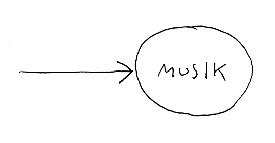
bereinstimmung: "extremely long" and "extremely short" voice
Verl ngerung: "Play extremely short tones"
Verk rzung: "Play extremely long tones"
Treffpunkt: "Everyone plays the same note."
Richtige Dauern: shorter and longer durations thematised.
Communication: different degrees of durations and dynamics
Wach: "abrupt end".
Wach: "With Dialogues".
Also mentions the following paragraphs the single note as a starting point: Treffpunkt, Richtige Dauern, bereinstimmung, Verk rzung, Verl ngerung, unbegrenzt, Intensit t, Goldstaub, Setz die Segel zur Sonne.
Extending structures which are defined:
Interval: follow a shape form where two notes upgraded to a chord with ten notes, then back the same way.
Schwingung: process with stages
Zugvogel: process with stages
Wach: end down
Oben und Unter: end down
OMRIDSE (there seems to be a certain notion of the sounding of the basic, but the description is not clear):
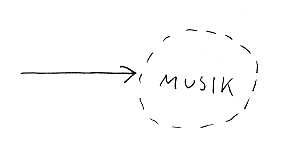
"Metaphorically-objective":
Zugvogel: "Play / sing it in parallel with the other as possible"
Vorahnung: "Put each note on a different tone"
Ausserhalb: "Break through someone else's tone"
Innerhalb: "'Enter the someone else's tone"
Spektren: "Divide someone else's voice"
"Metaphorically-poetic"
Zugvogel: "Fly Away"
Wach: "Star Constellations" - "Nocturnal Forest"
Innerhalb: "... until all the toner starts to burn"
In combination:
Setz die Segel ...: "Play a sound ... as long as you hear its individual vibrations" (likely to lead to long tones).
Setz die Segel: "Slowly move your tone you achieve perfect harmony ..." (Technique can hardly be other than what is called intonation).
Selected structures described in outline, the votes follows the same principle but with free individual variation:
Treffpunkt: free movement to and from a starting point
Richtige Dauern: durations vary individually 'seismographic'
bereinstimmung: to attempt to play more and more simultaneous bets
Wellen: call for intensified competition through the crunch
Ausserhalb: movement toward an end point
Innerhalb: movement toward an end point
Spektren: gradual evolution prescribed
SUGGESTING (described a notion that is very ambiguous in terms of it sounding and requires a particularly active, interpretative effort by the musician):

Verbindung, Nachtmusik, Abw rts, Aufw rts, Communion:
"... Your leds, cell ... the dream, the universe ... etc. rhythm"
Selected structures suggest:
Setz die Segel zur Sonne: the common voice to develop
CREATE (instructions do not appear to describe a particular type of music but a transaction which generates music):

ES: "Think NOTHING. Wait until there is absolutely still for you"
Intensit t: "Play ... so devotedly that you feel the heat rays from you"
Ankunft: "Everything you do is right and good, as long as you stay in this consciousness"
Verbal additions to the notation since the Baroque period constituted an essential complement both more concrete as more atmospheric descriptive elements. One can distinguish between tempo indications, lectures designations individual titles and specific instructions.
Compared with traditional music as a general rule for the examined newer material that verbal notation most used
- Description of the general characteristics of the sounding material (eg musical parameters; processes and their changes)
- Rules (including contingent contexts: if-then)
- Environment (eg, a course in outline) and
- Starting
rather than to describe rows of tiny individual elements, the notation does (29).
In Aus den sieben Tagen and F r coming Zeiten there are several different degrees of determination , referred to herein as to establish that omridse, to suggest and evoke. The first category, a relatively unambiguous definition of the musical material by means of words can be expressed in both material (duration, dynamics, pitch) as course structure (in stages, or fixed end). The processes often occur in combination - you can see the pieces as performers in types and mixed types.
The variation in ambiguity can for playing mean an opportunity to choose how big or small the freedom to be and where figuratively or specifically he / she will work. Some seem eg., The pictorial facilitates the process, others that it restricts freedom. Similar attitudes can be found in the audience: some would like to be seduced, others want to form their own ideas.
Where there was a clear formula like playing rule for the musical sequences was considered how this rule could be directional or directional indefinite in combination with mutable or immutable.
Major types of pieces in the collections may be mentioned specifically described structures, games that go on communication between the performers, pieces where a meditative transaction being steered and pieces with serial structures, symbolizing a diverse universe.
The analysis should drive a stake through the view that everything in Stockhausen's collections are vague and non-committal musical - the 31 pieces are not one but several kinds of things. You can choose both the concrete as the pictorial as the meditative from or you can choose it. And Stockhausen previous experience of producing both targeted and uncertain process allows the reduction of the music here, also developed the serial design principles for concise, lucid structures.
It examined the music of Anglo-Saxon origin is clearly different from much of Stockhausen. It is characterized by indeterminacy in its attitude and approach (30).
In Verbal Anthology , the pieces are often very elaborate - but it happens in differentieringens service, not to determine the process that goes "here" and "there" - indeterminate mode must just be vague. A single exception is Gavin Bryar's "1-2, 1-2-3-4," which gradually wear at all voices together in a chord. Mind you, this is done using a simple, almost mechanical arrangement which appears impersonal and not put up for subjective interpretations (31).
In contrast, course structures with Stockhausen often determined by further developments which musicians consciously medopleve. In short, have a consciousness dynamics influence on this process in which emotions also play a role, though also supposed to be to appease them and thereby attain the above personal. When such reverberation. in Setz die Segel zur Sonne are intoned in the direction of being as "gold" and "fire" is activated sensations and assessments of the players along the way, and some like feeling (for lack of better word) may ultimately the main directory for what qualifies as a successful, beauty characterized the final sound. There is a dynamism of European origin who "want something" and "will go somewhere else". - Thus reflects significant cultural differences in the repertoire also in this repertoire.
In analytical music therapy as it is practiced at Aalborg University, formulated often playing to therapy improvisations. Stockhausen's collections could be relevant to general inspiration from when it comes to "translate" a vague mood for a specific game instructions - a possible strategy of the therapist. E.g.. one could propose the theme "low notes" instead of "my inner gloom" - it could be an aid in getting mourns forward, or an indirect call which is sufficiently loose to gloom only appears if appropriate for the client. The collections could also inspire you to formulate good rules for the processing of emotions in dynamic process - the therapist must in both cases, of course, use your own imagination. Rules as the shorter, suggestive starting in Nature Study Notes and 1001 Activities could rather inspire a quest for more indeterminate phases of therapy.
A conclusion bordering on the very obvious but nonetheless maybe relevant to make explicit is this: What and how much can be notated using verbal language depends on those who do it. In itself, language is an extremely versatile tool to describe sound and music.

Publications which I am writing at present in AUB (Aalborg University, Langagervej) and AUM (Hand Library of Music and Music Therapy, Kroghstr de) are labeled with these abbreviations - it should not deter anyone from looking at the other.
Collections of verbally notated music (including depictions, which quoted here):
a) specifically mentioned in this production:
Brecht, George: Water Yam . NY (Fluxus), 1963, 1966.
Box with cards - approx. 70 in the first ca. 100 in the next edition. Another version is later than those issued by the Experimental Music Catalogue, London.
Cardew, ed.: Nature Study Notes . London, 1971.
"Improvisation rites" of members of the Scratch Orchestra. Texts with playing instructions, ranging from specific game rules for philosophical paradoxes. Some here quoted in Parsons: 25 Years from Scratch , see below.
Cardew (ed): Scratch Music . MIT Press (MIT 239 Music), 1974.
Contains "1001 activities" - almost an imaginative poetic brainstorm in its own right.
Michael Nyman: "George Brecht," Studio International , November / December 1976.
Interview with George Brecht, a variety of pieces from Water Yam cited.
Parsons, Michael (ed.): 25 Years from Scratch . Festival Program. Publ. by London Musician's Collective, 1994. AUB.
Contains blah. excerpts from Cardew (ed.): Nature Study Notes .
Stockhausen, Karlheinz: Aus den Sieben Tagen . Vienna (Universal Edition UE 14790), 1968. English version 1970. AUB.
Stockhausen, Karlheinz: F r coming Zeiten . 17 Texte f r Intuitive Music. K rten (Stockhausen-Verlag), 1970. AUB.
Verbal Anthology , London (Experimental Music Catalogue), 1972.
Wolff, Christian: Prose Pieces , London (Experimental Music Catalogue), 1974. In publishing catalog from Frog Peak Music (Lebanon, USA), 1994, appears under the name Prose Collection .
Young, LaMonte and Mac Low, Jackson (ed.): An anthology , publ. by Heiner Friedrich, USA, 1963.
b) Other Collections:
Bergstrom-Nielsen, Carl: Text Music 1975-91 . Copenhagen (Society for Ed. Of Danish Music), 1991.
Hegi, Fritz: Improvisation und Musiktherapie. Und M glichkeiten Wirkungen von freier Music Paderborn (1986), 4 Aufl., 1993. AUB.
With a large and diverse collection of exercises that take points in both the psychological as in the musical.
N ss, Tom: Audio and growth . Nesoddtangen (Musikkpedagogisk Publishers), 1989.
Describes improvisation in music therapy with different audiences. S. 87-90 good exercises that can be used for intuitive improvisation. AUB.
Stevens, John et.al.: Search and reflektere. A music workshop handbook . London (Community Music), 1985.
Heart rate and rhythm exercises, improvisation exercises.
Streiff, Peter: Particle 1-7 (1970-72). Zurich (Music Hug No. 11190), 1978. Part of a series: Schweizerische Music des 20 Jahrhunderts .
Simple, minimalist pieces.
Vetter, Michael: Pianissimo. Improvise am Klavier. Eine Rezeptsammlung . Zurich / Mainz (Atlantis Music Buch-Verlag), 1996. With CD. AUB.
Vincze, Ivan: Texts for intuitive music (Texte f r Intuitive Music / Texts for intuitive music). Copenhagen (Society for Ed. Of Danish Music), 1994. AUB AUM.
Oliveros, Pauline: Sonic Meditations I-XII . In: Johnson, Roger (ed.): Scores. An anthology of New Music. USA (Macmillan Publishing Co.. Inc.), 1981.
Other literature, etc.. :
Bailey, Derek (1992): "The composer - in question," Improvisation. Its Nature and Practice in Music , S. 79-81. Dorchester (The Brit. Libr. Nat. Sound Arch.). AUB AUM.
Comments by Hugh Davies to play Stockhausen Intensit t. Made dialectically against Evan Parker is talking about improvisation versus playing freely improvised
Bergstrom-Nielsen, Carl (1979): Research on Concept of Experiment role in Western art music after 1945 (konferensspeciale, Copenhagen Univ.)
Bergstrom-Nielsen, Carl (1981): "Meditative listening way," bindu No 18. (Scandinavian Yoga and Meditation School).
An excerpt from my thesis, easily processed by Ed. Bla. I will refer to Swami Janakananda meditation instruction to Antar Mouna (Inner silence) and Stockhausen Setz die Segel zur Sonne. Also published in Swedish (No. 18) and English (no.2).
Bergstrom-Nielsen, Carl (1996): "Wie die composer ihre Music liebten. Klangsensualismus als wesentliches Merkmal des fr hen Serialismus" MusikTexte 62/63.
Bergstrom-Nielsen, Carl (1997): "Party Legen, Umreissen, Andeuten, Hervorrufen. Analytisches zu den Textkompositionen Stockhausen" MusikTexte 72 November
Blumr der, Christoph von (1993): Die Grundlegung of Music Karlheinz Stockhausen . Stuttgart (Franz Steiner Verlag). Beihefte zum Archiv f r Musikwissenschaft, Vol XXXII .
S. 167f are considered the serial approach in some pieces from Ad7T.
Boj , Harald (1978): "Aus den sieben Tagen. Textinterpretationen" Feedback Papers 16 , August.
12 of the pieces in Ad7T are detailed comments for the practical interpretation. Boj was a member of the group who toured with Stockhausen in 1968-70.
Brindle, Reginald Smith (1986): The New Music: The Avant-garde since 1945 . Oxford (OUP), 1975 - sec.ed. 1986. AUB AUM.
General book on new music, despite a good deal of skepticism also treats themes like improvisation and new notations on almost exemplary manner.
Brinkmann, Reinhold (1974): "H ren und Denken. Thesen zur" intuitiven "Music", Neue Zeitschrift f r Musik No.9 , Sept.
Marxism, which also provides an example of the absolute allergy to anything that is non-rational and meditative.
Childs, Barney (1974): "Indeterminacy", Art. in Vinton (ed.): Dictionary of Twentieth-Century Music (1971). London. AUB.
Short and very important text on one of the major directions in experimental music.
Davies, Hugh (1975): "Stockhausen's Intuitive Music" Music's 1 april / may.
General introduction to Aus den sieben Tagen.
Dean, Roger T. (1989): Creative Improvisation: Jazz, Contemporary Music and Beyond . Milton Keynes (UK) / Bristol (USA) (Open University Press).
Practical exercises also in the experimental context. Thus, the section on "Timbres and textures for Improvising" - "Combining and responding" - "Improvising inden twentieth-century compositions" and "Texts and visual stimuli for Improvising" (among others with a discussion of how Stockhausen Setz die Segel ... can interpreted).
Frisius, Rudolf (1996): Contributions to Art. "Improvisation" (among others about improvising., And improv.p d. 1900s) in Die Musik in Geschichte und Gegenwart (Finscher, Ludwig ed.) Zweite, neubearbeitete Ausgabe. Kassel, etc. (Metzler B renreiter +). AUB.
Good summary of the development, especially in the context of the development of new notation.
Kurtz, Michael (1988): "Aus den sieben Tagen (1968-70)," Stockhausen. Eine Biographie . Kassel (B renreiter).
Biographical material as well as material about the performances from this time.
Lekfeldt, J. (1991): S lle and Stockhausen - music, theology and theology music . My einer deutschen Zusammenfassung. Viborg (Sch nberg). AUB.
In music analysis and general philosophical basis compared Stockhausen's musical S lle theology. Both are seen as an expression of emancipative / utopian modernity. Just merits of the musical elements author as a key concept in Stockhausen - an aesthetic principle, which began at the parameters and their step deli's equality in the serial music. In ambiguous notation music, also both musicians and various performances are equal.
Maconie, Robin (1976): "Aus den sieben Tagen" + "F r Upcoming Zeiten", The Works of Karlheinz Stockhausen , p.250-261st London.
Analytical comments.
M ller, Hermann-Christoph (1997): "plus minus gleich. Karlheinz Stockhausen's" Prozession " MusikTexte 67/68, January.
Nevill, Tim (ed.) (1989): "Intuitive Music", p.35-44 Towards a Cosmic Music , Longmead, Shaftesbury, Dorset (Element Books Ltd.). AUM.
Contains blah. an interview with Stockhausen in 1973.
Michael Nyman (1976): "George Brecht," Studio International , November / December
Interview with George Brecht, a variety of pieces from Water Yam cited.
Pedersen, Inge Nygaard and Scheiby, Benedikte Barth (1983): "We zooms us into music therapy - No, not music therapy, but music therapy," Opposing players no 21. 19 pages.
Bla. discussion and classification of different rules.
Saraswati, Swami Janakananda (1975): Yoga, Tantra and Meditation in Daily Life . Copenhagen
Stockhausen, Karlheinz (1959): "Musik und Sprache" die Reihe 6 , Vienna (UE) cop 1960.
Stockhausen, Karlheinz (1971A): "Aus den Sieben Tagen", Texte III , S. 123-125. Cologne (DuMont), 1971. AUB.
The first introductory text to Ad7T. A revised version of the accompanying booklet (German or English) to Stockhausen Complete Edition, CD 14A-G, 1993.
Stockhausen, Karlheinz (1971b): "Intuitive Music", Stockhausen on Music . Lectures and interviews compiled by Robert Maconie, S. 112-128. London Marion Boyars Publishers), cop, 1989.
Excerpts from a lecture by Stockhausen from 1971. There are Two examples of how musicians have fleshed out the performances in the "cosmic" pieces.
Stockhausen, Karlheinz (1978a): "Aus den sieben Tagen. 15 composition, Mai 1968", Texte IV , S. 108-129. Cologne (DuMont). AUB.
Introduction Texts, blah. them from pladeomslagene.
Stockhausen, Karlheinz (1978b): "Fragen und Antworten zur intuitiven Music", Texte IV , p 130-144. Cologne (DuMont), 1978. AUB.
A very recommendable text. Questions and critical comments from an audience discussion of Stockhausen. Also printed in ledsageheftet (German or English text - the latter with AUB) to Stockhausen Complete Edition CD Nr.14A-G, 1993.
Stockhausen, Karlheinz (1987): interview with n rv. ancestors., Odense. Not published.
Stockhausen, Karlheinz (1993): "Aus den sieben Tagen. 15 composition, Mai 1968", Texte IV , S. 108-129. Cologne (DuMont). AUB.
Introducing texts, including those from the previous record covers, to 12 of the pieces. Also available in ledsageheftet (German or English) to Stockhausen Complete Edition CD No 14A-G: "Texts about the recordings." This last issue is reviewed, which is now the 12 pieces on the CD are reprinted in their entirety. It is therefore nearly a nyudgave of construction material.
Sutherland, Roger (1994): New Perspectives in Music . London (Sun TavernFields), 1994. AUM AUB.
Music History book also covers improvisation in different contexts.
(1) The completion of this article has been pleased to see how Frisius (1996), column 592, assess developments in art music involving improvisation after 1945 in line with the undersigned and identifies some of the same things as central: "In the 1950er und 1960er Jahren haben mit Aspekten there Unbestimmtheit operierende Graphische und verbal notation zentrale Bedeutung erlangt (vgl. LaMonte Young, 1963, Christian Wolff, Prose Collection, 1968 C. Cardew, Nature Study Notes, 1969) ... ".
(2) Davison, Archibald D. and Apel, Willi (ed.): Historical Anthology of Music , Volume II, London (Oxf. University Press), 1950, No. 276, 277 and 265
(3) Klaversonaterne 23-29 incl. (Ed. Peters No 1801c).
(4) Davison, Archibald D. and Apel, Willi (ed.): Historical Anthology of Music , Volume II, London (Oxf. University Press), 1950, No. 189
(5) Photocopy, Ed. Wilhelm Hansen, Copenhagen
(6) Nyman (1976), p 256 These other exx. from the collection Water Yam .
(7) See. George Brecht on Water Yam in 1972: "scores of music, events, dance ..." Nyman (1976), s.265, note 2
(8) See Young, LaMonte and Mac Low, Jackson (ed.) (1963).
(9) Note: Cit. Parsons (1994), p.13
(10) Note: See Young, LaMonte and Mac Low, Jackson (ed.) (1963), para. "George Brecht Indeterminacy Music Compositions". Similar produced pieces found here by Joseph Byrd, Toshi Ichiyanagi and Christian Wolff - the latter two are also known otherwise as composers outside the Fluxus context.
(11) Robert Ashley, Gavin Bryars, Phil Gebbett, Christopher Hobbs, Hugh Shrapnel is represented. London (Experimental Music Catalogue), 1972. Same publisher stood for Scratch Anthology of compositions , dated june 1971, a collection of mixed notated pieces.
(12) Release year indicated somewhat confusing as both 1973 and 1970 in Sutherland (1994), pp. 145 and 257 1974 I have from a copy of Experimental Music Catalogue series.
(13) From own notes as a participant. - The accompanying booklet to the CD with Mikrophonie In Others works Stockhausen Edition 9 seems even some more sounds to be described.
(14) Adieu f r Wolfgang Sebastian Meyer (for wind quintet). Vienna (UE 14877), cop, 1969, 2 Aufl.
(15) "Adieu f r Wolfgang Sebastian Meyer" (1967), Texte III , Cologne (DuMont), 1971, 92
(16) See Kurz, Michael Stockhausen. Eine Biographie. Kassel (B renreiter), 1988, pp. 213 f
(17) Stockhausen (1987).
(18) Brinkmann (1974).
(19) M ller (1997)
(20) Sutherland (1994).
(21) Boj (1978)
(22) Brindle (1986), s.96f.
(23) Stockhausen (1978b).
(24) See Bergstrom-Nielsen (1979) and (1981). Ang. yoga meditation, see also Saraswati, Swami Janakananda (1975).
(25) Es may be difficult or inaccessible to non - meditation usual, but this particular piece is perhaps even a shortcut to meditation for musicians. For a for velse as recommended Treffpunkt which just allows a similar process to take place, with smaller steps and in less fluctuation! To think absolutely nothing for a long time is difficult or impossible. But you sit to wait, which meant the here and let the mind settle down, their activity after all less. One should find a position that allows one to sit still and like to close your eyes, at least in the beginning. This can cause breaks where one's body or the outside world just sensed and recorded without thought. This is a favorable time to play - the sound may enhance the dormant sense without thinking where only the sound followed. In this way it will be possible anyway. - As Stockhausen notes (Stockhausen 1978b), the piece tends to start with breaks and short bursts. This recurring nature does not mean that it used to dedicate myself in a kind of trance in which I act automatically while I play. Characteristic is that I am on a tape recording can hear myself from the outside, like a stranger. In my experience causes play a purge of tension and powerful impulses, a kind of expressionistic essence in pure form. So what I have heard till now is not a quiet emptiness - perhaps a tordnen that suggests emptiness behind. The play properly can give music a virtually unheard of immediate nature. It is far from the conscious beauty growing, what makes the experience very direct and personal. - As a listener, I can rejoice in the absence of redundancies and bluntly!
(26) Type I - the pieces are the easiest to access. This is a form of minimalism, as in the first two paragraphs give the clear reflected in the music, and the next two are certainly a unifying mood or character, while you gather can be perceived as pleasant . But visualization exercise in Ankunft can be difficult to make sense of just from reading if you have not tried the layer before and prepared it with simpler exercises and Goldstaub to be attributed to a special practice for particularly motivated. Type II-pieces and the following category, except admittedly from Setz die Segel zur Sonne, are not suitable for the most delicate and most vulnerable people.
(27) See Bergstrom-Nielsen (1979 and 1996) on the perception of composers like Herbert Eimert, Karel Goeyvaerts and Paul Gredinger besides Stockhausen.
(28) "Musik und Sprache", Darmstadt Beitr ge zur neuen Music I , Mainz (Schott), 1958 and die Reihe 6, Vienna 1960.
(29) Rows of many individual elements are found in the works of Christian Wolff, who use characters other than ordinary nodes, for example. Duet In the 4-hand piano (1963 or before, reprinted in An Anthology ... ), Duet II for piano and horns (Ed. Peters, cop 1962), Pairs (cop 1968) and Burdocks (1970-71) .
(30) Indetermination is an attitude to music and designation of compositional techniques that seek the indeterminate and each sound's individuality. Indeterminacy related to American music by Cage and the New York school and what associated with this. It is contrasted European embossed concepts aleatorics and stochastic music which conversely aimed at controlling processes that may have randomness in the details. See Childs (1974).
(31) Another word for this is minimalism, and despite the perhaps paradoxical, it is a historical fact that indeterminacy and minimalism are related in this quest against the impersonal and objective in addition to geographical / cultural. The conscious ego and its performances sought bypassed from the start.